Questions, methods
& contributions.
Four areas of work spanning experimental biomechanics, computational movement analysis and industrial sensing. Open a project to explore the methods and my contribution.
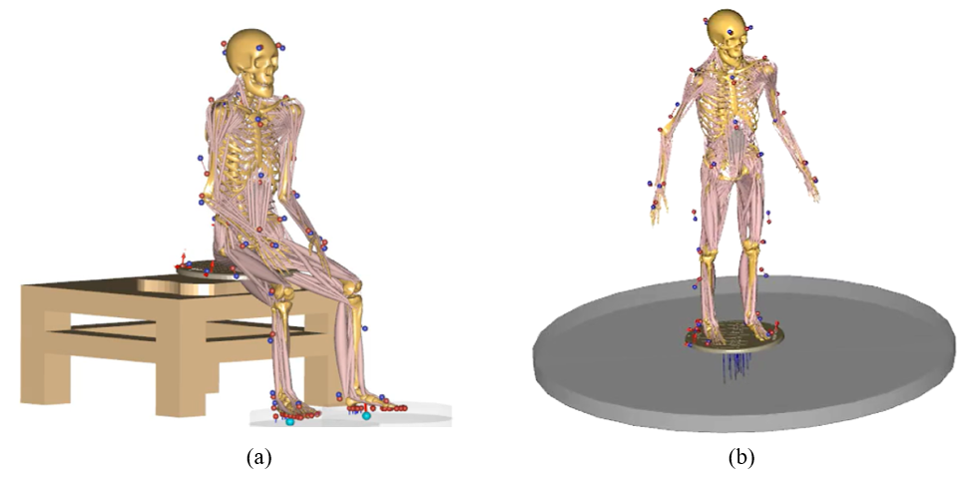
01M.Sc. thesis · In progressSpine biomechanics on a smart balance board
Spine biomechanics on a smart balance board
Research question
How can measured balance-board movement be linked to trunk-muscle forces and lumbar spinal loading in seated and standing tasks?
My contribution
I preprocess and integrate motion-capture, force-plate, surface EMG and board-tilt signals, and adapt an existing AnyBody full-body model to represent contact between the body, balance board and ground.
Methods
Multimodal signal processing, Vicon motion capture, force measurements, surface EMG, AnyBody musculoskeletal simulation and comparison of model outputs with measured activation patterns.
Outcome & current status
A pilot first tested the full acquisition, synchronisation, modelling and validation workflow. Data from 20 healthy participants have since been collected and are now being analysed. Results are not yet published.
02IEEE conference publication · 2025Gait complexity in children with cerebral palsy
Gait complexity in children with cerebral palsy
Research question
How can kinematic synergy analysis be used to study gait complexity and adaptability in children with cerebral palsy?
My contribution
I contributed to the coding for this study, including processing the gait kinematic data and extracting the kinematic synergies.
Methods
Human-movement analysis and kinematic synergy analysis.
Outcome & current status
Published in the 2025 Iranian Conference on Biomedical Engineering (ICBME), pp. 269–274.
03Research projectLearning to predict three-dimensional posture
Learning to predict three-dimensional posture
Research question
Can learned models predict three-dimensional human posture during load-handling activities while maintaining geometric consistency?
My contribution
I developed and evaluated Python-based Kolmogorov–Arnold Network models, including data preprocessing, model training and quantitative validation of prediction accuracy and generalisation.
Methods
Kolmogorov–Arnold Networks, structured biomechanical data, regression and geometric-consistency metrics. The project also examined a simple biomechanical constraint.
Outcome & current status
Developed and evaluated models for three-dimensional posture prediction, assessing prediction accuracy, generalisation and geometric consistency.
04Industrial R&D · Two conference contributionsComputer vision and deep learning for laser inspection
Computer vision and deep learning for laser inspection
Research question
How can laser-line images support weld-path detection and geometric inspection of rubber gaskets?
My contribution
I developed image-processing and CNN-based methods for laser-edge weld-path detection, and developed and experimentally validated a linear laser-triangulation system for geometric measurement.
Methods
Industrial cameras, laser-line sensing, optical filtering, MATLAB and Python, image preprocessing, feature extraction, and deep-learning segmentation (U-Net with a ResNet34 encoder).
Outcome & current status
Two conference papers in 2024: laser-edge welding path detection, and rubber-gasket profile extraction (profile measured with a mean absolute error of about 0.04 mm). A follow-up feasibility study covered the optical design and a U-Net segmentation model for weld-seam detection, reaching 89% mIoU at 128×128 input and running at 20 frames per second. Real-time integration with the welding machine was outside the scope of this study.